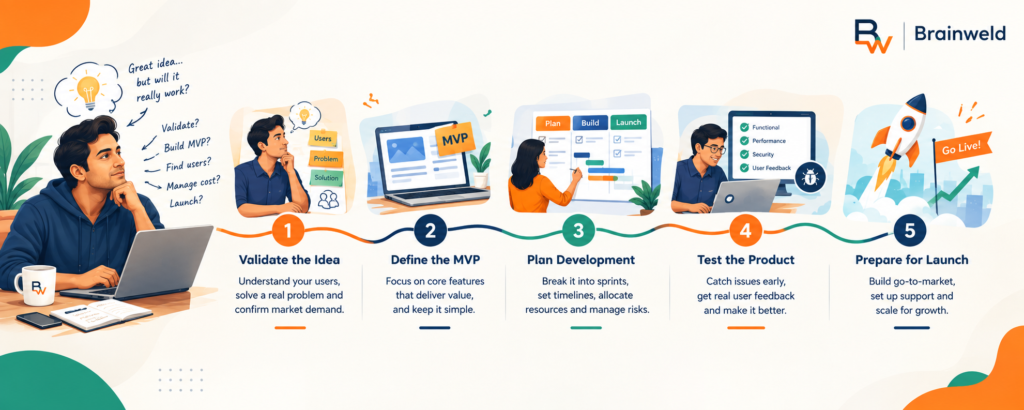
Any product development starts with an idea, but this idea rarely goes further than a concept and turns into a product that people are willing to spend money on.
There is a long way from the initial idea to a working MVP, and a product development team should ask themselves many questions before they proceed to design and launch a product. What problem will the product solve? Who will be the target audience for the product? What functions and features should the product have? What should the developers prioritize while creating the product? How much time and money should be spent on the product at least to ensure that it will be viable?
For most founders, reducing the development costs and making the product launch as soon as possible is crucial, and this product development checklist will help them with that. It serves as a reminder of what steps need to be taken before designing and developing an MVP.
Define the problem before the product
The first thing is to stop thinking about your app or the technology you are going to use. Focus on the problem that needs to be solved. The most successful products are usually driven by a specific problem that a well defined set of users will encounter.
Ask yourself the following questions:
- What problem are we trying to solve?
- Who has this problem?
- How are they currently solving this problem?
- Why is their solution inadequate?
- How often do they encounter the problem?
- Are they willing to pay for a better solution?
A simple problem statement could look like this:
We help X, solve Y by doing Z.
Identify Your Target Users
Without defining the problem you are trying to solve there is a huge risk that you will start developing features without a purpose. Your MVP (Minimum Viable Product) should not aim to solve all problems at once.
Therefore, narrow the focus of your product.
For example, think about:
- what industry/profession are your users in,
- how big is the company they work for,
- where is it located,
- what tasks do they perform,
- what tools do they use,
- what are their biggest pains,
- are they paying for such products.
Talking to your potential users can help you identify some things that you have not taken into account. User interviews, surveys and meetings will help you find out if there is a need for your product.
Validate the Product Idea
Before you sink a lot of time into building a product, test the idea to see if it has any potential. Sometimes it’s not worth developing a product based on an idea with no market fit.
Depending on the idea, you can use a variety of methods to test the viability of the product, including:
- Customer interviews
- Landing pages
- Prototypes
- Surveys
- Waitlists
- Manual service experiments
- Proof-of-concept builds
- Small-pilot programs
The point is, you want to get some form of evidence that potential customers would be interested in the product/service and that it actually solves their problems.
Carry out Market and Competitive analysis
Your product is not an island. Research similar products, possible competitors and alternative solutions.
Such factors as:
- The set of features that is offered,
- A price policy,
- A target audience,
- User reviews,
- The product’s strengths and weaknesses,
- Market share,
- And customer support
Researching the efforts of your competitors will not necessarily mean copying their product. This may help to find a niche or need in the market.
Sometimes the solution consists not in creating something new but in making an existing technology more cost-effective, convenient, time saving or targeting a particular group of consumers.
Define the MVP Scope
This stage happens to be among the most critical ones in a product development cycle.
The MVP (Minimum Viable Product) should embody sufficient features to enable you to solve the leading problem and allow you to attain feedback from the target audience. It is essential to keep in mind that it should not comprise all the features that one intends to add.
Consider developing three different categories of features:
Must-Have Features
These are fundamental aspects that a product must possess to meet its intended purpose.
Should-Have Features
They should augment the first category of features mentioned above.
Later
These are the aspects that one can add at a later time.
This technique can help one to avoid the feature creep trap that is rather frequent during the development cycle of products.
Map the User Journey
Before diving into development, it is critical for designers to understand exactly how users are going to use your product.
Define the key points from start (open the app) to finish (achieve the goal).
For example:
Sign Up → Onboarding → Discover → Take action → Get value → Return
For each step, ask yourself the following questions:
- What the user needs?
- What information should he/she enter?
- What action should he/she take?
- Where he/she can get confused?
- What can be made easier?
A proper mapping will allow you to design better and faster.
Create Wireframes and a Prototype
Once the product flow is defined, it is time to turn it into a visual representation. Using wireframes, you can sketch the future appearance of your product on a screen. Then, a clickable prototype can be built from them, which simulates the appearance and functionality of the product.
Creating a prototype is extremely helpful because:
- it allows the founder to test the product’s flow
- find out possible usability issues
- describe the product to investors
- collect feedback
- make necessary adjustments without spending much money
The prototype can be modified several times until the desired result is achieved, after which the final version will be ready to develop the application itself.
Choose the Right Technology
Technology decisions should be driven by the product and not the other way around.
Depending on your requirements, you may have to strategize on such aspects as
- web or mobile application,
- native or cross-platform development,
- backend architecture,
- database,
- cloud infrastructure,
- APIs,
- third-party integrations,
- AI or machine learning components, authentication, and security.
The technology stack should be selected based on the product requirements. its anticipated audience, scalability needs, budget constraints and roadmap. For MVP, it is better to avoid any technological complexities that are not mandatory.
Plan the Development Roadmap
Divide the MVP into development stages.
A standard roadmap might look like this:
Discovery → UX/UI Design → Development → Integration → Testing → Launch
Within the development process break down larger features into smaller deliverables.
It helps the team to prioritize and provides the founders with the ability to track progress on an ongoing basis rather than waiting for the end result.
Build With Scalability in Mind
An MVP should be simple, but it should not be sloppy.
The architecture of your first product should be designed in such a way as to allow for the necessary reserves for anticipated changes and enhancements.
Make sure you leave enough room for:
- Code quality
- Database structure
- API architecture
- Security
- Performance
- Error handling
- Monitoring
- Data protection
- Future integrations
You want to avoid making the wrong technical decisions that would impede your ability to enhance the product and make it more profitable in the future.
Test Before Launch
Testing the product should not be postponed until the end of the development cycle. It should be implemented throughout the process and throughout the features being built. The following elements need to be taken under the QA umbrella:
- Functional requirements
- User flows
- Mobile responsiveness
- Performance
- Security
- Forms and their validations
- Integrations
- Notifications
- Payments (if applicable)
- Cross-browser and cross-device
The MVP of the product needs to be tested by real users before the big launch, as it might be technically perfect, but not intuitive enough.
Launch With a Feedback Loop
Launching your MVP is just the beginning of the product development cycle, not the end.
Track:
- User activation
- Feature usage
- Where users drop off
- Retention rates
- Conversion stats
- Customer feedback
- Support requests
- Technical problems
Don’t be tempted to measure everything your analytics tools can collect. Instead, narrow your criteria and track the metrics that will help you get the answers you need most.
Prioritize What to Build Next
Once you’ve launched your product, avoid building every proposed feature. Instead, study real-life user behavior and feedback and ask yourself:
- What are they struggling with?
- What are they using?
- Where are they getting frustrated or abandoning the product?
- What are customers complaining about?
- What would have the most impact?
Prioritize the next set of features based on this information.
This creates a virtuous feedback loop that lets you continually improve and refine your product.
Build → Launch → Learn → Improve → Repeat
Product Development Checklist for Founders
Before starting your MVP development, make sure that you address all the following questions:
Idea & Problem
- Is the problem clearly defined?
- Is the expected outcome clear to you?
- Can you define the user persona?
Market Validation
- Did you do your competitor research?
- Did you validate your idea?
- Is your product something users really need?
- Was your concept stress-tested?
MVP Strategy
- Is the product’s value clear to you?
- What features should your MVP include?
- Did you identify what features can be cut for the later releases?
- Is the MVP success definition clear to you?
UX & Design
- Is there a user journey map?
- Are all the key screens sketched out?
- Did you design a clickable prototype that has been tested?
- Are you optimizing the prototype?
Technology
- Is there a rationale for the tech stack choice?
- Did you identify all the 3rd party services that you may need?
- Are you aware of all security concerns?
- Is your MVP’s architecture future-proof?
Development
- Is there a development roadmap?
- Are there clearly defined requirements?
- Are there any specific milestones?
- Will there be any testing?
Launching
- Is your MVP ready for launch?
- Is the analytics tracking set up?
- Will the user feedback be captured?
- Do you have a development plan for the post-launch period?
Common Mistakes Founders Should Avoid While Building an MVP
Building too many features into the MVP
While having a lot of features would, at first glance, seem to provide more value, a narrow focus on an MVP actually provides a much clearer idea of what a user would really need.
Skipping out on the validating process
A common mistake while developing a product and waiting for it to be discovered by the target market is extremely costly and wasteful.
Premature prototyping
Creating the system before designing the problem leads to excessively complicated systems.
Neglecting the end-user experience
Even in the best-solution scenarios, complicated design can thwart even the most brilliant ideas simply because an average user would not be able to understand it.
Considering the MVP as a finished product
An MVP is, in fact, only the beginning of the product’s evolution and should be regarded as such.
From Product Idea To MVP With BrainWeld
The process of turning ideas into products is a multifaceted one that extends beyond coding.
Throughout the product development life cycle in our company, the combination of product strategy, user experience, technology, artificial intelligence and engineering enables organizations to transform their initial ideas into a validated digital product.
The process may involve idea discovery, product validation, UX/UI design, MVP development, integration of AI, testing and continuous product improvement.
The emphasis is placed on understanding the business problem first and then determining the appropriate technology and development methodologies to solve them.
Whether you are looking to test out a startup idea, build a digital product, or turn an innovative business concept into a digital product, a well-defined product development process can serve as an excellent guide in stripping away the excess and focusing on the essentials that need building.
Final Thoughts
Turning ideas into MVPs in no about speed, but about the right design.
It is all about prototyping what you think it is and testing them with real-world user and learning before you invest more.
The most critical aspect of product development for founders is to ensure a coherent connection between the problem, users, product and business.
Use this product development checklist as a living document for your product development process, and as you learn from your users, and the market, your product development roadmap should evolve according to this learning.
A solid MVP is not an end but a beginning of a product development process that creates products that people desire.