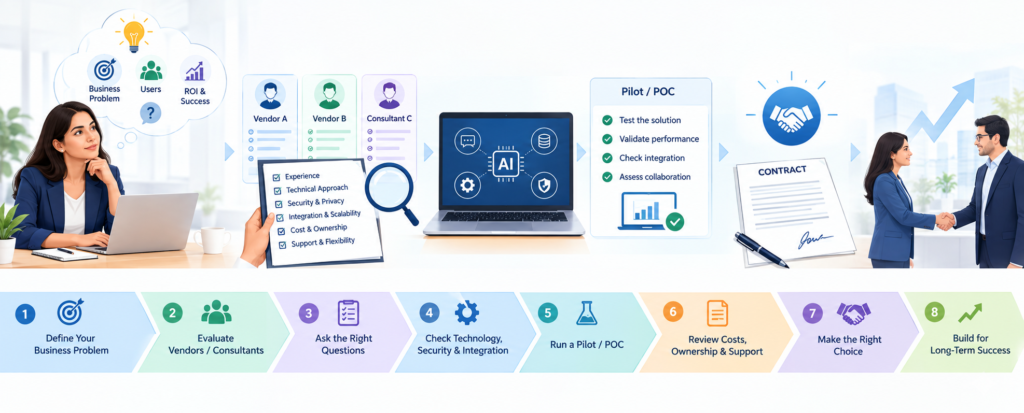
How non technical founders should evaluate an AI vendor or tool
Artificial intelligence (AI) can be a powerful lever for enterprises to digitize recurring processes, enhance customer experiences, analyze unstructured data and create products in a better way. However a choice of the right partner for AI implementation can be overwhelming.
Most vendors tend to overcomplicate things, and use dozens of various terms, from machine learning algorithms to API, LLM, vector databases, RAG, fine-tuning, and AI agents. It takes a considerable effort and time to grasp all the nuances but not everything is that simple.
A prospective buyer should ask the right questions and have a general vision of what can go wrong to choose the trustworthy vendor or how to evaluate AI vendors and avoid thousands of dollars being wasted on a failed experiment.
Start With the Business Problem, Not the AI Tool
One of the biggest mistakes that founders make is to start with an AI tool, rather than the business problem. For example, “we want an AI chatbot”, but why do you need a chatbot? Is it because your customer service is too slow? Are your leads not qualified? Are your employees spending too much time answering repetitive questions?
Before choosing an AI vendor, make sure that you define-
- what problem you want to solve,
- who has to use the solution,
- how the process is currently working,
- how much time or money it is costing the company,
what is a successful outcome and how are you going to measure the improvement. A good AI vendor will first ask these six questions and will not start with their technology.
How To Evaluate AI Vendors: 8 Things to Check
There is no universal set of criteria to evaluate AI vendors. Anyway, below is the list of points that every founder should take into account while comparing candidates.
1. Does the Vendor Understand Your Business
Technical expertise is essential but it is also essential that the vendor understands the business processes of the client.
If you talk to a vendor for the first time, ask attention to their questions. If they try to understand your customers, the technology you are using, your business objectives, and pain points – this is a positive sign. Do these people jump to conclusions and solutions right away, or want to understand the real business challenge first? Be wary of vendors that immediately offer a specific model. Instead, look for partners that can see how to apply technology to your needs.
2. Ask them to describe the solution in detail
Avoid any vendor that offers vague answers. Even if a company offers an appealing idea, ask specific details. You will want to know:
- What part of the solution is powered by AI?
- What is standard software?
- What AI models or APIs will be used?
- Will the solution make use of third-party APIs?
- Does the project require custom development?
- How will the AI handle incorrect outputs?
- Can you customize the solution?
- How will it be integrated with your software?
You may not know the technical details, but you must understand what you will be paying for and what technology is going to be used in your solution.
3. Ask About Possible Inaccuracies
Most of the time, the AI solution will not be 100% accurate. For example, you may get wrong answers, unclear responses or unexpected results depending on the use case scenarios.
Ask potential vendors how they plan to deal with inaccuracies when you vet an AI tool. Below are some questions to consider:
- What accuracy benchmark will you use?
- How will you detect incorrect responses?
- Can users report incorrect outputs?
- Will there be a human in the loop?
- How will you monitor performance after launch?
- How often will you retrain the model?
Ask vendors to describe the limitations of their proposed solution, instead of getting promises that AI will solve everything.
4. Ask About Data Privacy and Security
This is a critical point, especially if your AI application will handle customer data, personal information, finances, business-critical information or other sensitive data.
Make sure to ask the following questions:
- Where will my data be stored?
- Who will have access to it?
- Will customer data be used to train other AI models?
- What data security measures will you implement?
- How will data be exchanged between our systems?
- What happens to my data if we cancel the contract?
- What third-party services for AI are you going to use?
You may also want to ask about your rights and obligations regarding data privacy laws and contractual rules before you send any data to a third party.
A reliable vendor will be transparent about how data is handled, rather than hiding the details. In many cases, data privacy and security are integral parts of the overall solution so it is always important to go through this step.
5. Ask About Integration and Scalability
It is hard to overestimate the importance of these two factors.
First of all, ask vendors how their solution will be integrated with your existing software. Ideally, the solution should be compatible with the following:
- CRM,
- ERP,
- Websites,
- Mobile applications,
- Databases,
- Communication systems,
- Payment systems,
- And other software.
You may also want to ask how the AI application will scale as your user base and data volume grow.
Another critical scalability-related question is about technical architecture. You will want to make sure that the solution will handle your needs at different stages of development. In other words, the application should not require significant architectural changes when the number of users grows from 100 to 10,000.
6. Look beyond the Development Cost
Most founders care about the price but it is important to understand that the initial AI development quote is only a small part of the equation.
When choosing an AI vendor, consider the following:
- Development cost,
- AI model or API cost,
- Cloud service cost,
- Storage cost,
- Maintenance and monitoring cost,
- Security cost,
- Third-party software cost,
- Future development,
- Support.
Ask vendors for a detailed breakdown of costs. This way you will understand what expenses are recurring and what are one time.
7. Ask About Ownership and Vendor Lock-in
Make sure to clarify who will own the software, code, scripts, documents, prompts and other assets produced during the development. Ask the following question:
If we change the vendor after two years, could another contractor modify the software to meet the requirements of the new developer?
A reliable technology partner should not try to tie you to them forever. Ideally, there should be no more than one vendor in the value chain. In other words, if you choose a vendor that uses a third-party AI API, make sure that this API can be replaced if needed. The same goes for other components.
8. Ask to pilot the solution
Most vendors understand that it makes no sense to develop a large-scale solution before you try a prototype or pilot. Use the discovery phase to discover how the vendor communicates, how professional they are, how disciplined they are, what quality of work they deliver, what suggestions they make, how transparent they are, how easy it is to work with and how well they understand your needs. In general, a pilot will give you a good idea of how you want to continue working with the selected vendor.
It is always a good idea to request a pilot before hiring an AI vendor. This way, you can test the cooperation dynamics and avoid wasting time and money if the vendor turns out to be unsuitable.
AI Vendor Evaluation Checklist for Founders
Use this checklist when evaluating a vendor:
- Business understanding: Demonstrated knowledge of your business problem
- AI justification: Value proposition for using AI for this case
- Technology: What models, APIs, and stack are used
- Accuracy: Testing and monitoring of solutions
- Data: Where your data is hosted and processed
- Security: Security measures
- Integration: Systems’ integrations
- Scalability: Ability to scale
- Cost: Upfront and recurring costs
- Ownership: Ownership of the software and project
- Support: Support after launch
- Flexibility: Being able to switch vendors
How to Vet an AI Tool Before Buying It
Not all requirements are for a custom-developed AI tool. Sometimes there already exists an AI tool that would satisfy a company’s requirements more efficiently than developing a new one.
While vetting an AI tool that already has a user base, besides looking at the features list, one should consider:
- Use-case fit: Does it meet your specific need?
- Adoption: Are your employees going to embrace it?
- Systems connection: How well does it connect to your other systems?
- Content: What happens to your data when you put it in it?
- Reliability: Can you trust it?
- Cost control: Is it affordable at scale?
- Support: Do you have support if something goes wrong?
- Exit options: Can you get your data out of it if you want to make a switch?
One must also keep in mind the contract exit clauses and the ability to extract data from the vendor. A potential tool that sounds fascinating with a broad list of features may fail to address a specific use-case, ultimately muddying the waters for the employees that have to adopt the new system.
AI Consultant vs AI Vendor: What’s the Difference?
The key difference between the two types of providers is the scope of services.
An AI consultant typically provides advisory services including analyzing your business, opportunity for AI application, and recommending a strategy and appropriate technology, whereas an AI vendor provides a particular AI product, platform, development and implementation service.
In some cases companies can be both.
As a founder who does not have a technical background, the important issues to raise are not about their different roles but rather whether one can be objective in giving advice and helpful in the implementation.
If you need help to understand what can AI do for you business, you may want to consider consulting or discovery before you commit to a significant implementation. At here, BrainWeld would be right choice for you.
If you already have a clear idea about what you want to build, you may look for an AI development or technology partner.
Red flags to watch for
Be wary of AI vendors that-
- promise guaranteed results of implementation with no information on possibilities and limitations
- employ too much jargon in order to obscure their ignorance of your particular business processes
- are not forthcoming on data privacy procedures
- do not provide an explanation of additional costs
- deny any responsibility over the ownership of the work product
- push a particular technology with no understanding of your requirements
- have no defined QA process
- are unable to provide relevant experience
- make everything contingent upon the use of their proprietary system
- believe that AI is a cure-all for every business need
A vendor may exhibit some of these red flags and still be a good fit for your organization. However, it is important to follow up with any vendor that displays any of these traits and ask them to clarify their position or process.
The Right AI Vendor Should Reduce Complexity
You do not need to become an expert AI engineer to be able to make a sound technology choice.
As a founder, your responsibility is to understand the business outcome, risks, investment, and long-term implications — your technology partner needs to make this as simple for you as possible to understand and control.
The best evaluation process is therefore not about finding the vendor with the fanciest AI-speak — it’s about finding a partner that can connect the dots between business requirements, technology, data, security, user experience, and outcomes.
At BrainWeld, we offer strategic consulting on AI opportunities, proof of concept, AI product development, automation solutions and technology implementation, all of them driven by specific business requirements. The key here is to understand the problem first before thinking about a possible technology solution.
Frequently Asked Questions
How do you evaluate AI vendors?
I would begin by looking into the vendor’s understanding of your business problem, technical approach to solving the problem, accuracy of the AI, security, options for integration, scalability, cost, code ownership, and long-term support. You might be able to start with an initial pilot with the vendor to help you understand their skill and viability before committing to a longer-term engagement. As always, go through your particular requirements and goals and make sure the vendor has the capability and interest in your space.
What questions should one ask an AI vendor before signing a contract?
I would ask the vendor to walk me through their proposed technology stack, data considerations, security considerations, AI model, accuracy, integrations, ongoing costs, intellectual property considerations, maintenance and support, scalability, and exit strategy.
How can a non-technical founder evaluate an AI product?
Non-technical founders should ask at what business problem the product is aimed to solve? how accurate and trustworthy is the AI? how they will treat their data? how to integrate it into their stack? what is the total cost of ownership and whether they will be able to export their data if they decide to stop using the product.
What is the difference between an AI consultant and an AI vendor?
An AI consultant will typically work with you to advise on what you should build or recommend a solution to solve your business problem. An AI vendor is usually in the business of providing products, platforms or development services to build your AI application or solution. Some consultants also provide development services.
How can a non technical founder evaluate an AI product?
Non-technical founders should ask about the business problem the product is designed to solve, the accuracy and reliability of the AI, how their data will be handled, how the product integrates with their existing stack, the total cost of ownership and whether they can export their data if they decide to stop using the product.