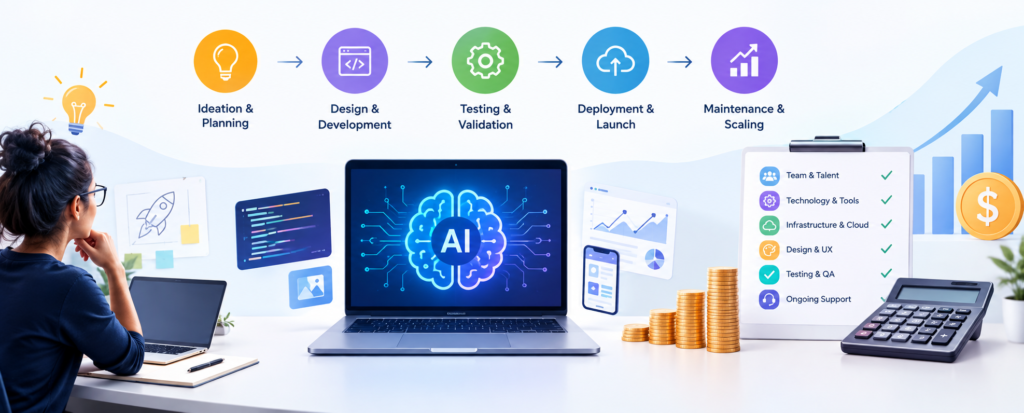
Creating AI products in-house is no longer the domain of billion-dollar technology giants. More and more companies, including start-ups, scale-ups, and even established corporations, are turning to artificial intelligence to design smarter software, optimize their operations, improve customer experience and create innovative products.
The most common question about building AI products concerns costs:
how much does it cost to create an AI product in 2026?
Unfortunately there is no definite answer since everything depends on a product’s scope, data strategy, integration needs and infrastructure. While a small-scale proof of concept can be built with a few hundred thousand Rupees, an end-to-end enterprise-grade AI platform may cost tens of millions.
This article highlights key factors that shape AI product development costs in 2026, provides ballpark figures for prototyping and production and helps startups and enterprises alike to estimate their own needs and budget constraints.
How Much Does AI Product Development Cost in 2026?
A practical way to estimate AI product development cost is to divide the project into different development stages.
| AI Product Type | Approximate Cost in India | Typical Timeline |
| AI Proof of Concept | ₹3–8 lakh ($3,100–$8,300) | 3–6 weeks |
| AI MVP | ₹15–25 lakh ($15,600–$26,100) | 6–12 weeks |
| Production AI Product | ₹40–60 lakh ($41,700–$62,500) | 3–6 months |
| Advanced AI Platform | ₹70 lakh–₹1 crore+ ($72,900–$104,200+) | 6–12+ months |
| Enterprise AI Platform | ₹2 crore+ ($208,000+) | 9–18+ months |
Note: These are estimates; actual prices depend on the scope of the product, the technical architecture selected, data requirements, technical integration, security, choice of AI model, team structure and ongoing maintenance. Recent 2026 industry ranges show similar variability. For instance, a simple AI assistant connected to one knowledge base can be significantly cheaper than an enterprise AI platform connected to CRM, ERP, internal databases, multiple workflows and business-critical systems.
What Is an AI Product?
An AI product refers to software in which artificial intelligence plays a significant role in its functionality.
It can take various forms, such as:
AI-powered SaaS
- AI customer service
- AI sales assistant
- AI document processing
- AI recommendation
- AI mobile application
- AI healthcare
- AI recruitment
- AI business automation
- AI analytics
- AI agent (software that performs business tasks)
It is essential to note that developing an AI product consists of more than just creating an AI model. A product involves user interface, back-end, databases, API, authentication, security, testing, deployment, monitoring, and maintenance. Therefore, the cost of developing an AI product is substantially higher than the price of tying an application to an API.
What Are the Main Factors That Affect AI Product Development Cost?
Several factors can significantly change the final development budget.
Product Complexity
The first issue is the product’s complexity.
A simple AI chatbot with several predefined workflows will have a different design than the chatbot that can analyze the input data, make recommendations, execute certain actions and interact with external systems. The more features the product has, the more development, testing and maintenance it will require.
AI Features and Capabilities
The AI’s features will also impact the budget significantly.
The list of possible features includes –
- AI chatbot
- Generative AI
- Recommendation system
- Predictive analytics
- Computer vision
- Speech recognition
- Natural language processing
- AI agents
- Rag knowledge base
- Multi-agent workflows
- Custom machine learning models
A product that only requires the implementation of already trained models using an API will be developed faster and may cost less than the one that requires custom training or the creation of an underlying ML infrastructure.
Data Requirements
Data is one of the areas that companies often fail to account for.
If your AI product needs to work with company documents, customer data or product info, historical transactions and other internal data, this information will have to be gathered, prepared, organized, secured and integrated into the application.
For RAG-based systems, in particular, the quality of information and its preparation can directly impact the quality of the outcome.
Integrations
AI products rarely work on their own.
You may need to integrate the solution with:
- CRM systems
- ERP systems
- Payment gateways
- Email platforms
- Cloud storage
- Accounting software
- HR systems
- Databases
- Business APIs
- Internal enterprise software
Each additional integration requires development, testing, security and maintenance work.
User Experience and Product Design
Although AI might be the secret ingredient that drives your product, it is not the only element that delivers value to the user. It is crucial to consider what else the users will experience on their way to enjoying the services of your product. The product development process might include the following:
- UX research
- Wireframes and UI design
- Responsive web design and mobile app design
- Dashboard and admin panel UI design
- User onboarding and notifications
- UX/UI for role-based interfaces
Therefore, your product will need a UX/UI design that will go far beyond just the AI model.
Security and Compliance
The security of the product is one of the most important aspects if one contemplates building an AI product that works with the data of one’s business or customers. Some of the most important features in this space include:
- Secure authentication and role-based access
- Data encryption
- Access audit logging
- Controlled access
- Secure API architecture
- Data retention procedures
- Secure compliance controls and monitoring
Healthcare and financial industries, insurance, and other fields that demand stricter regulations are likely to require additional measures.
AI Product Development Cost by Development Stage
Instead of looking at the whole project as something expensive so it’s easier to separate the development process into different stages.
Stage 1 — Discovery and Product Strategy
Before building the product, you need to discover what the product will be used for.
This stage could include –
- business requirement analysis,
- user research,
- competitor research,
- defining AI use cases,
- planning product architecture,
- selecting the technologies,
- defining MVP,
- and development roadmap.
One of the most important things during the discovery phase is to avoid costly mistakes that could occur at the later stages.
Stage 2 — Proof of Concept
A proof of concept is used to answer the question if a certain idea could work.
For example, you may wish to see if your future AI platform could really process documents before you start building the whole system. A PoC normally doesn’t concern with building a finished product, but rather proving the technical feasibility of a certain AI-assisted solution.
Stage 3 — AI MVP Development
An MVP contains the smallest amount of features that are necessary for a product.
These features can include:
- User registration
- Core AI feature
- Basic dashboard
- Database
- One or two integrations
- Basic administration
- Deployment
All of this is required to truly understand the MVP at the hands of real customers before investing in much more sophisticated additions.
Stage 4 — Production Development
With an MVP validated, products can move onto production development that adds much more to the products.
This stage could involve:
- Enhanced performance
- Sophisticated workflows
- More integrations
- UX improvements
- Security controls
- Analytics
- Monitoring
- Automated testing
- Highly scalable infrastructure
- Enhanced administration
This stage is usually much more involved and requires significantly greater investments than what went into the MVP.
Stage 5 — Maintenance and Optimization
AI products need to be maintained and optimized after their release.
Some of the costs of AI products can include:
- Cloud hosting
- AI model or API usage
- Bug fixes
- Security upgrades
- Model testing and evaluation
- Performance monitoring
- Enhancing existing features
- Adding new data
- Scaling infrastructure
Therefore, its initial budget should not be considered as the entire cost of an AI product over its lifespan.
AI Product Development Cost by Product Type
Now, let’s look at different types of AI products, how much effort and budget they need.
AI Chatbot
An elementary AI chatbot is relatively simple to build if you use an existing model and limited data from your business.
However, a more sophisticated chatbot that involves CRM, conversation history, analytics, human operators and multichannel communication will require much more effort.
AI SaaS Product
An AI SaaS product generally involves a product with multiple users, subscriptions, dashboards, authentication, billing, administration, AI features, and cloud infrastructure.
Therefore, developing SaaS software is generally more complicated than just an AI feature.
AI Business Automation Platform
An automation platform can involve AI technology, CRM, ERP, email, documents and various workflows, and internal systems. The complexity usually depends on the number of processes and the degree of automation.
AI Agent Platform
AI agents can involve a wide range of features and tools. They can perform repetitive tasks by using external tools, API, business logic or workflows. A simple AI agent can consist of a single workflow, while an enterprise-level solution may involve multiple agents, permissions, approval, audit and human tasks.
AI-Powered Mobile Application
An AI mobile application generally requires both AI development and mobile app development. The budget for such a product may involve:
- iOS development
- Android development
- Backend development
- AI development
- APIs
- Database
- Authentication
- Push notifications
- Admin panel
- Cloud infrastructure
How Much Does an AI MVP Cost in 2026?
For startups, an MVP (Minimum Viable Product) is often the most reasonable choice.
Current 2026 estimates for Indian AI products put MVP budgets in a broad range depending on the scope. Some suggest a focused AI MVP would be between ₹8 to 15 lakh, and more involved MVP’s can reach ₹20 Lakhs or more.
One realistic AI MVP may consist of:
- 1 primary AI use case
- User auth
- Core application UI
- AI model/API
- Database
- Basic admin panel
- 1 or 2 integrations
- Hosting on a cloud
- Basic analytics
The aim should not be to create everything at once. The aim should be to create enough to prove that users need the product, and that the AI functionality brings valuable function to the table.
How Much Does It Cost to Build an AI SaaS Product?
While AI-powered SaaS products usually require more than just the AI model itself.
For an AI SaaS platform, you could need:
- User accounts
- Subscription management
- Payment processing
- AI model
- Monetization tools
- User limits
- Dashboard
- Admin panel
- Storage
- Notifications
- Analytics
- Security
- Cloud hosting
And the list goes on. Depending on your idea and target audience, you’ll have to choose what features to prioritize. A minimal viable product (MVP) of an AI SaaS app can cost anywhere between the lower end of our estimation spectrum. However, if you want a fully fleshed-out platform with multiple monetization options, advanced dashboard, and enterprise-level security, you’ll be looking at hundreds of lakhs for development.
As seen in the 2026 AI SaaS MVP cost in India, rates can vary drastically, so it’s essential to have a better idea of what you want before contacting developers.
AI Product Development Cost in India vs Other Markets
The location of developers can affect the final price but it shouldn’t be the sole selection criterion.
An Indian development team will have a different cost structure as compared to the US-based, UK-based, or Western European counterparts.
However, the selection criteria may include:
- Experience
- Project management
- Technical architecture
- AI capabilities
- Communication skills
- Time zone differences
- Development methodologies
- Security measures
- Quality control
- After-hours support
A lower hourly rate doesn’t necessarily mean a lower overall cost. A poorly organized technical structure, ill-defined requirements, or multiple redevelopment cycles can cause serious increases in the final price.
What Makes an AI Product More Expensive?
Some requirements could make the development budget substantially bigger.
Custom AI model development
It may be much more resource-intensive than using an existing foundation model to build and train the specialized model.
Custom model development may involve data gathering and labeling, model training and evaluation, machine learning infrastructure, model deployment and monitoring.
Large-scale data processing
Products that process thousands or millions of documents, transactions, images, or conversations daily need much sturdier data pipelines and infrastructure.
Multiple AI Models
Some products may need multiple models for different functions.
For example, one may be needed for text generation, another one for image processing, and one more for classification and analysis.
Complex data integrations
Integrating an AI product with multiple data sources and enterprise systems adds another level of complexity which raises development and testing costs.
Enterprise security
Enterprise customers often have strict requirements, including SSO, permissions, audit trails, private deployment, security assessments and many others.
Hidden Costs in AI Product Development
There are often additional expenses that are not included in the development quotation.
These can include:
- AI API
- cloud hosting
- database
- vector database
- storage
- monitoring
- security
- third-party APIs
- software licences
- testing
- maintenance
- technical support
- model evaluation
AI API costs can be particularly unpredictable as they can depend on which model is used. OpenAI, for example, has separate prices for input, cached input, and output tokens for each of its models.
This is why budgets for AI products should be planned with ongoing costs in mind and not just the initial development costs.
How to Reduce AI Product Development Cost Without Reducing Quality
Reducing cost does not necessarily mean picking the cheapest development team. A better alternative is to reduce the scope of your development requirements to only the necessary items.
Start With One Strong Use Case
Do not try to build ten different AI functions. Instead, try to zero in on the one problem that will create the biggest business value.
Build an MVP First
Before you start building your AI platform you need to test and validate your ideas. Do not fall into the trap of big-enterprise thinking and create an MVP, a Minimum Viable Product, instead.
Use Existing AI Models Where Practical
You do not always need to train a new model for whatever product you are building. You might be able to leverage an existing foundation model if it fits your product requirements.
Prioritize Integrations
Focus on the tools and systems that are central to your product development. You can always add other systems later after you have proven your product has value.
Design for Scale, But Do Not Overbuild
Your design should be able to scale as your business grows, but you should not overbuild your system and spend too much money on an enterprise level infrastructure, right from the start.
Should You Build an AI Product In-House or Hire an AI Development Company?
It depends on your business, team, timeline and technical needs
In-House Team
An internal team offers direct control over the development process however hiring AI engineers, product developers, designers, DevOps specialists and QA professionals can be time- and resource-intensive.
Hire AI Development Company
A development partner can offer a proven team that includes product managers, UI/UX designers, AI engineers, software development team, QA specialists, DevOps and more.
This is a great option for a startup that wants to build an MVP without incurring huge costs in hiring a full-time team.
The choice between outsourcing and hiring an in-house team depends on your product, your internal competencies, budget and long-term goals.
How to Estimate Your AI Product Development Budget
How To Estimate Your AI Product Development Budget
List of the questions to ask yourself before hiring a development company:
- What business problem will your product solve?
- For what audience does your product make sense?
- What would be the main AI feature of the product?
- What data will the AI analyze or work with?
- Do you need an AI model or do you want to integrate an existing one or API?
- What platforms do you want the product to be available on?
- What systems should it synchronize with?
- How many user roles do you want to have?
- What security standards should the product meet?
- What should the MVP of the product include?
- What features can be deferred to future sprints?
- How many users do you expect to have upon launch?
- What is the expected monthly cost of maintaining the product?
- What should the team do after the launch?
These questions will help you understand how to scale your initial idea into a working prototype.
Example AI Product Budget
Example of AI Product Budget
Imagine a situation where a start-up wants to develop a new AI-based SaaS application. In such a case, the company could plan to build at least the following features in the first versions:
- The web application itself;
- User registration and authorization;
- AI assistant;
- Upload of documents;
- Knowledge discovery;
- Basic dashboard;
- Administration panel;
- One third-party integration;
- Hosting on cloud platforms;
Instead of going after the advanced analytics, numerous integrations, mobile versions, model training, and enterprise security at once, the company could save money and time by developing the bare minimum first. It would give the company an opportunity to see if there is a market for the product at all.
What Should You Ask an AI Product Development Company?
Before signing a development contract, make sure to ask –
What will be included in the scope
The proposal needs to detail what features, platforms, integrations and deliverables will be included.
Which AI model or technology will be used
Ask why a particular model or architecture was chosen.
What are the expected running costs?
The costs of API, clouds, storage, databases and other expenses should be itemized.
Who owns the source code
Ownership and access to the code should be clearly stated in the contract.
What happens after launch?
Ask about maintenance, support, monitoring, bug fixes and future development.
How will performance be measured?
The value of a working AI feature is not always obvious, so this call should define what success means. For example, accuracy, response quality, processing speed, conversion rate or task completion rate (if applicable).
Why AI Product Development Should Start With the Business Problem
One of the biggest mistakes businesses make is starting with technology instead of the problem.
The better approach is:
Business Problem → AI Opportunity → Product Strategy → MVP → Validation → Production → Scale
For example, instead of saying: “We want to build an AI chatbot.”
A better product question is: “Which customer-support tasks are consuming the most time, and can AI handle them reliably?”
The second approach gives the development team a clearer objective and makes it easier to measure whether the product is actually delivering value.
Why Choose BrainWeld for AI Product Development?
We help early-stage companies and established businesses to design and develop a product that will be able to solve real-world problems.
Our team will work with you to understand your business need and pick the most fitting technology and approach for development.
Depending on the scope of the engagement, your AI product development may involve:
- Product discovery
- AI use-case identification
- Product strategy
- UX/UI design
- AI product engineering
- AI SaaS development
- AI application development
- API and third-party integration
- Backend development
- Cloud deployment
- QA
- Product maintenance and support
Instead of thinking of an AI product development as a standalone challenge, we approach it as a part of a larger business process.
Whether you have an idea, MVP requirements, or a legacy software that you want to transform into an AI-enabled product, the first thing we will do is discuss your goals, expected outcomes, and scope of changes.
Final Thoughts on AI Product Development Cost in 2026
There is no standard cost for developing an AI product. A focused AI proof of concept can cost a few lakhs while a production or enterprise-ready AI platform can cost several tens of lakhs or more. As per 2026 market trends, one must consider the impact of architecture, data, integrations, security, infrastructure and product complexity before estimating AI development cost. Thus, the wrong question to ask here is:
How to make the cheapest possible AI?
While the right question should be:
“What is the smallest possible working AI product that we can build and iterate?”
To put it another way: for a start-up or a growing business, focusing on a focused MVP (Minimum Viable Product) can help reduce costs while still getting critical user feedback. And then, one can always add more features, functions, automations, and enterprise-grade capabilities later.
Frequently Asked Questions
How much does AI product development cost in 2026?
The cost of AI product development can range from tens of thousands of rupees for a narrow proof of concept to ₹1 crore or higher for enterprise-grade solutions. Multiple factors determine the final range.
How much does it cost to build an AI MVP in India?
The cost of building an AI MVP in India can range from roughly ₹8–20 lakh depending on the scope and focus area. Smaller POCs can cost considerably less and some MVPs can go well beyond this range.
How much does it cost to build an AI SaaS product?
An AI SaaS MVP can also fall within the lower end of the AI product development range, while a production-level SaaS product with subscriptions, integrations, advanced AI workflows, analytics and enterprise features can extend well beyond this range.
What is the biggest factor affecting AI development cost?
The product complexity is one of the biggest factors; others include data requirements, the type and extent of required integrations, security requirements, AI architecture, anticipated user base and infrastructure requirements.
Is AI product development expensive?
It can be, but not necessarily; many types of AI products do not require a significant initial investment. An AI MVP built around an existing model can be significantly cheaper than an enterprise-level solution with a custom model.
Can startups build AI products with a limited budget?
Yes; a startup can begin with a focused MVP that addresses a particular need or serves a particular function and later iterate upon the MVP to expand its capabilities and/or audience.
Should I build a custom AI model?
Not necessarily; many products can be built around an existing foundation model or API. Custom large language models or similar architecture should be considered if there is a specific need for data, performance, privacy or other considerations that existing solutions do not address.
What are the ongoing costs after launching an AI product?
The ongoing costs for an AI product can include expenses related to AI APIs, cloud infrastructure, databases, storage, maintenance, security, support, and future development.
How long does it take to build an AI product?
An AI product development timeline can vary greatly depending on the solution’s scope and features. A proof of concept can take a matter of weeks, while an MVP can take several weeks to a few months. Enterprise-grade or large-scope products can take six months or more.
How can I get an accurate AI product development estimate?
To get an accurate estimate, it is necessary to identify the target audience, the business problem to be addressed, required features, platforms, integrations, data requirements, and security requirements. Having a general idea of the MVP to be built will allow for a more accurate commercial and technical estimation by an AI product development company.
Related Topic: Strategy & Fractional CTO Services for Startups & SMEs, Startup Business Strategy & Growth Consulting